Epigenetic Clocks for Clinical Trials
Epigenetic age monitoring: a new paradigm beyond genetic testing
Why Epigenetics, Not Genetics
DNA methylation study differs from genetic testing because your epigenetics are modifiable - enabling you to determine if your health is improving over time.
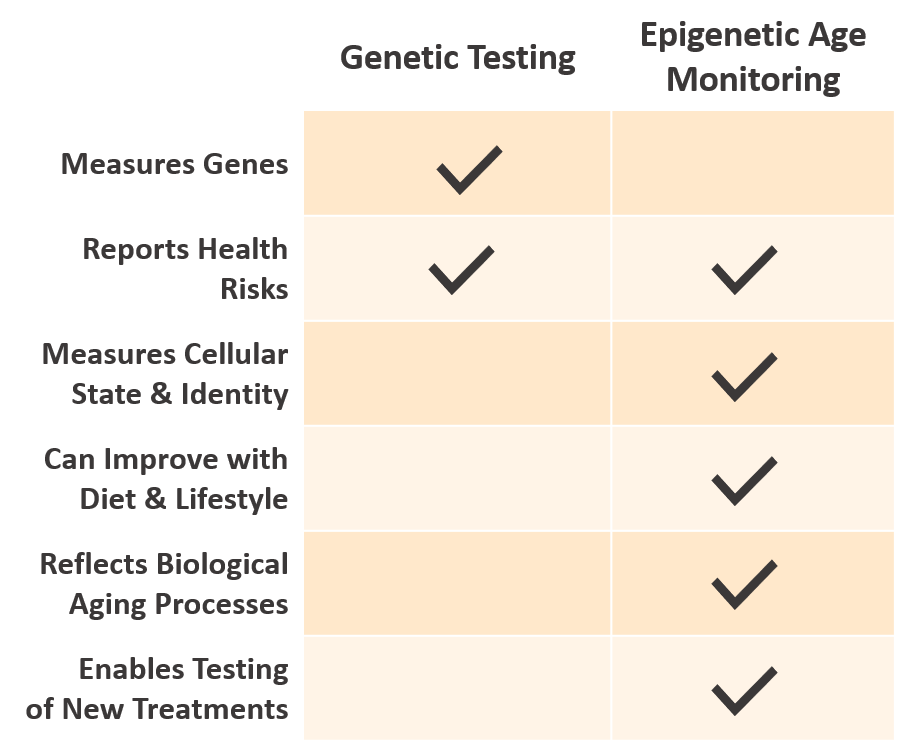
Biological age is a much better predictor than your actual age for major health risks. Epigenetic aging clocks represent robust composite measures, more akin to composite measures of frailty, but with superior monitoring capabilities throughout a lifespan.
All of these epigenetic clocks can be measured conveniently using the same Illumina EPIC methylation array - with no added cost or inconvenience compared to running just one.
Four Validated Epigenetic Clocks
All measurable from the same Illumina EPIC array - at no additional cost or inconvenience.
Predicts healthspan and lifespan with strong performance across diverse populations. Currently the most widely used clock in longevity intervention research.
We report GrimAge2 (Lu et al., 2022) alongside the original 2019 version. Version 2 adds DNAm surrogates for C-reactive protein and HbA1c to the original components, predicts mortality better across racial and ethnic groups, and extends validity to younger participants and to saliva samples. Both are reported, so a trial already baselined on the 2019 clock keeps a comparable series.
Enables prediction of healthspan and lifespan based on phenotypic biomarkers. Highly sensitive to lifestyle interventions and treatment effects.
Predictor of chronological age that is accurate across all human tissues - the original Horvath clock that launched the field of epigenetic age research.
Highly accurate chronological age predictor optimized for skin and blood samples - ideal for intervention studies using standard blood draws.
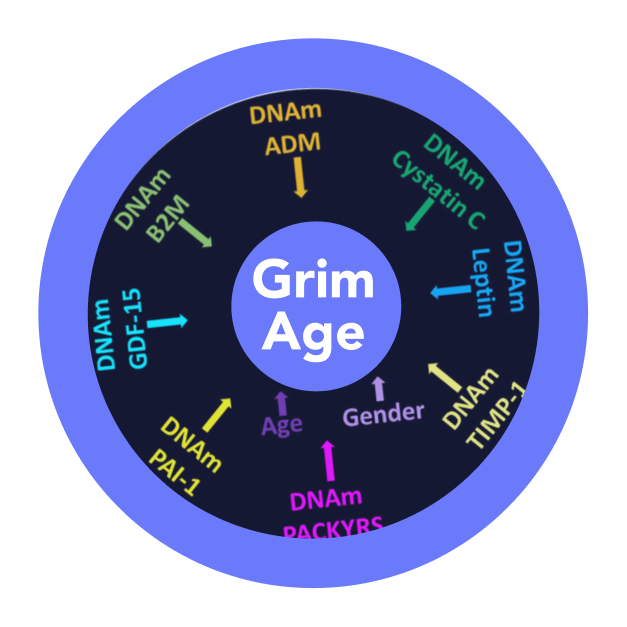
What GrimAge measures, and what version 2 changed
GrimAge is not a direct age predictor. It is a composite of DNA methylation surrogates for plasma proteins and smoking pack-years, trained against time to death, which is why it tracks healthspan and mortality risk rather than chronological age.
GrimAge2 (Lu et al., 2022) keeps those components and adds DNAm surrogates for C-reactive protein and HbA1c. It predicts mortality better across racial and ethnic groups, associates more strongly with coronary heart disease and reduced lung function, and extends validity to younger participants and to saliva samples.
We report both versions on every result set, so a trial already baselined on the 2019 clock keeps a comparable series while gaining the newer estimate.
Key Scientific References
-
Horvath, 2013 - DNA methylation age of human tissues and cell types
Genome Biology 14:R115. The pan-tissue clock that established the field.
-
Levine et al., 2018 - An epigenetic biomarker of aging for lifespan and healthspan
Aging (Albany NY) 10(4):573-591. PhenoAge, trained on clinical phenotype rather than chronological age.
-
Lu et al., 2019 - DNA methylation GrimAge strongly predicts lifespan and healthspan
Aging (Albany NY). PMID 30669119. The original GrimAge.
-
Lu et al., 2022 - DNA methylation GrimAge version 2
Aging (Albany NY) 14(23):9484-9549. PMID 36516495. Adds the CRP and HbA1c surrogates.
How to Get Started
Integrating epigenetic clocks into your study is straightforward. Here's the three-step process.
Sample Collection
Blood samples are recommended. Collect at least two baseline samples prior to treatment, as well as two samples after treatment, for robust longitudinal measurement.
Raw Methylation Testing
Uses the Illumina Infinium MethylationEPIC BeadChip array, interrogating more than 850,000 CpG methylation loci per sample. The gold standard for epigenetic age research.
Results & Interpretation
Raw data can be submitted to Clock Foundation or the Horvath Lab for analysis, quality control, and scientific interpretation. We provide full support.